

If the thought of your first smear test makes you feel anxious, you are not alone. Many women — and people with a cervix — feel nervous before cervical screening, particularly if they are unsure what to expect. As a consultant gynaecologist, I see this regularly in my clinic, and I can tell you: the anticipation is almost always worse than the procedure itself.
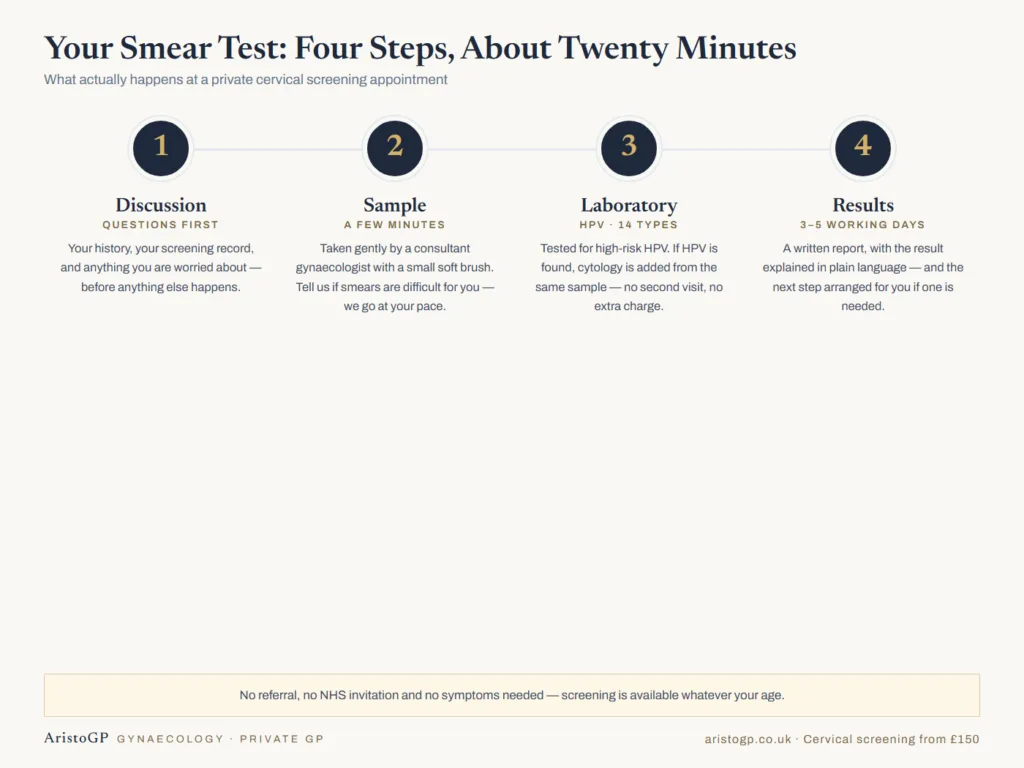

In this guide, I will walk you through exactly what happens at a smear test, step by step, so that you feel informed and prepared. Cervical screening is one of the most important health checks available to women — it has significantly reduced rates of cervical cancer in the UK — and understanding the process can make a real difference to your experience.
What Is a Smear Test?
A smear test — more formally known as cervical screening — checks for the presence of high-risk human papillomavirus (HPV), the virus responsible for the vast majority of cervical cancers. It is important to understand that a smear test is not a test for cancer. It is a preventative check that looks for changes in the cells of the cervix before any problems develop.
During the test, a small sample of cells is taken from the surface of the cervix using a soft brush. These cells are then examined in a laboratory to detect HPV. If high-risk HPV is found, the sample is also checked for any cell changes. Caught early, these changes are straightforward to manage — which is exactly why regular screening matters.
The procedure itself is quick and straightforward, usually taking no more than two minutes once you are in position.
When Should You Have Your First Smear Test?
In England, the NHS invites women for their first smear test at age 25. After that, the standard schedule is:
- Ages 25–49: every 5 years if HPV negative (changed from 3 years in July 2025)
- Ages 50–64: every 5 years
If you are under 25 and sexually active, private cervical screening is available — I would encourage you to speak with a gynaecologist if you have any concerns. There are also several reasons why women choose private smear tests regardless of age:
- You are overdue and want to be seen promptly
- You prefer to see a female consultant
- You want faster results
- You would like a full consultation alongside your screening
- You find the NHS setting difficult due to past experiences
How to Prepare for Your Smear Test
A little preparation can help ensure you get an accurate result and a more comfortable experience.
- Timing: Try to schedule your appointment mid-cycle — ideally around days 10–20 of a 28-day cycle. Avoid booking during your period, as blood can affect the quality of the sample.
- Intercourse: Avoid sexual intercourse for 24 hours before your appointment.
- Vaginal products: Do not use vaginal creams, lubricants, or tampons in the 48 hours before the test, as these can interfere with the sample.
- What to wear: Comfortable clothing is ideal. You will only need to undress from the waist down, so a skirt or loose trousers can make this easier.
- Your feelings: It is completely normal to feel nervous. Please let your doctor know — we will take things at your pace.
What Happens During the Test — Step by Step
Knowing exactly what to expect can take away much of the anxiety. Here is what happens at a smear test appointment at AristoGP.
Step 1: Consultation
Your appointment begins with a short consultation. Your gynaecologist will review your medical history, ask about your menstrual cycle, and give you the opportunity to ask any questions. There are no silly questions — this is your time, and it is important you feel comfortable before we proceed.
Step 2: Privacy and Chaperone
You will be asked to undress from the waist down behind a privacy screen. If you would like a chaperone present during the examination, simply ask — this is a standard part of good clinical practice and nothing unusual. You may also bring a friend or family member for support.
Step 3: The Procedure
You will lie on your back on the examination couch with your knees bent and feet flat, or with your feet in supports — whichever is more comfortable. A speculum — a small smooth instrument — is gently inserted into the vagina. This holds the vaginal walls apart slightly so that the cervix is visible. A soft brush is then used to collect a small sample of cells from the surface of the cervix.
The collection itself takes around 2 minutes. At any point, if you feel uncomfortable or wish to stop, please say so — we will pause immediately.
Step 4: Afterwards
Once the test is complete, you get dressed and can carry on with your day as normal. It is common to experience very light spotting or mild cramping for a few hours afterwards — this is completely normal and not a cause for concern. If you experience heavier bleeding or significant pain, contact your clinic.
Does It Hurt?
This is the question I hear most often, and I want to give you an honest answer. Most women describe a smear test as uncomfortable rather than painful. The sensation is often described as a mild pressure or cramping — similar to period pain — that lasts only for the 2 minutes or so of the procedure.
A few things that can make a genuine difference:
- Relax your legs: Tension in your thighs makes the speculum more uncomfortable. Try to consciously soften your muscles.
- Breathe slowly: Deep, slow breaths help your body stay relaxed.
- Tell your doctor: If you are nervous, say so. We can talk you through each step as we go, and we can pause at any time.
- Smaller speculum: If needed, a smaller speculum is available. Just ask.
If you have had a difficult experience with smear tests in the past — including past trauma — please mention this during your consultation. There is no pressure, and we can adapt the approach accordingly.
Understanding Your Results
At AristoGP, results are typically available within 48 hours. Here is what the different outcomes mean.
HPV Negative
No high-risk HPV was detected. This is a reassuring result. You will be invited for routine screening again in 3–5 years, depending on your age.
HPV Positive, No Cell Changes
High-risk HPV was found, but your cells appear normal. This means the virus is present but has not caused any changes yet. A repeat smear test in 12 months is usually recommended to monitor this.
HPV Positive with Cell Changes
High-risk HPV was found and some cell changes (also called dyskaryosis or CIN) were detected. This does not mean you have cancer — most cell changes are low-grade and respond very well to treatment or monitoring. A colposcopy is usually recommended to take a closer look. AristoGP does not perform colposcopy; if you need one, Dr Mermigka can write a referral to a colposcopy service.
Inadequate Sample
Occasionally, the sample does not contain enough cells to give a clear result. This is not unusual and does not indicate a problem. A repeat smear is done after 3 months — this is provided at no additional charge at AristoGP.
What If My Results Are Abnormal?
Receiving an abnormal result can feel alarming, but it is important to understand that abnormal does not mean cancer. The vast majority of abnormal smear results relate to low-grade cell changes, which often resolve on their own without any treatment at all.
If further investigation is needed, a colposcopy allows your gynaecologist to examine the cervix more closely using a magnifying instrument. It is a straightforward outpatient procedure. Private colposcopy can be arranged promptly at AristoGP, promptly once your smear result is available.
Whatever your result, your gynaecologist will discuss the findings with you clearly and without jargon, and will outline any recommended next steps.
Tips for Making It Easier
Over the years, I have spoken with many women who have avoided smear tests due to anxiety. Here are some practical suggestions that patients have found helpful.
- Request a female doctor: At AristoGP, all smear tests are performed by me — a female consultant gynaecologist — so this is always the case here.
- Bring someone with you: A friend or family member can wait with you or even be present during the appointment if you prefer.
- Ask for a chaperone: A clinical chaperone can be present for reassurance and is always available on request.
- Wear a skirt or dress: Many women find it less exposing to partially undress this way, rather than removing trousers.
- Remember the scale: The test takes approximately 2 minutes. That small amount of time could genuinely make a difference to your long-term health.
- Talk about your worries: No concern is too small. If something is on your mind — a previous experience, a specific worry, a question about the procedure — please raise it. That is exactly what the consultation is for.
Frequently asked questions
What age should I get my first smear test?
The NHS invites women for cervical screening from age 25. If you are under 25, you can discuss private screening with a gynaecologist; at AristoGP it is available when it is clinically appropriate.
How long does a smear test take?
Taking the sample takes a few minutes. With time to talk and to get changed, the appointment lasts about 15 minutes.
Does a smear test hurt?
Most women describe it as uncomfortable rather than painful. It lasts a few minutes, and a smaller speculum can be used if needed.
How often should I have a smear test?
In England the NHS invites women aged 25 to 64 for cervical screening. If your last HPV test was negative you are usually invited every 5 years; you may be asked to come back sooner after an HPV-positive result.
Can I have a smear test on my period?
It is best to avoid a heavy period, as blood can affect the sample. Light spotting is usually fine; if you are unsure, message us before your appointment.
How quickly will I get my results?
At AristoGP, results are usually back within 2 to 5 days.
Book Your Smear Test at AristoGP
Smear tests at AristoGP are performed by Dr Anastasia Mermigka, a consultant gynaecologist and obstetrician. Appointments are available Monday to Saturday at our clinic at 1–5 Portpool Lane, London EC1N 7UU.
Results are typically available within 48 hours. For full details, visit our smear test service page.
| Service | Price |
|---|---|
| HPV Screening Test (UK method) | £150 |
| HPV Test + Pap Smear Together | £230 |
| Complete Well Woman Check (consultation, scan and HPV test) | £380 |
Prefer to get in touch first? Message us on WhatsApp and we will be happy to answer any questions before you book.
Related care and reading
Smear tests from £150, results in 2 to 5 days.