Consultant gynaecology · Central London EC1

Recurrent Urine Infections

Assessment for urinary symptoms that keep returning, with urine culture to confirm what is actually there before another course of antibiotics.

Recurrent cystitis is often treated repeatedly on symptoms alone. A significant proportion of those episodes are not bacterial infection at all, and the treatment that helps is different.

Consultant-led · Urine culture and sensitivities · From £200

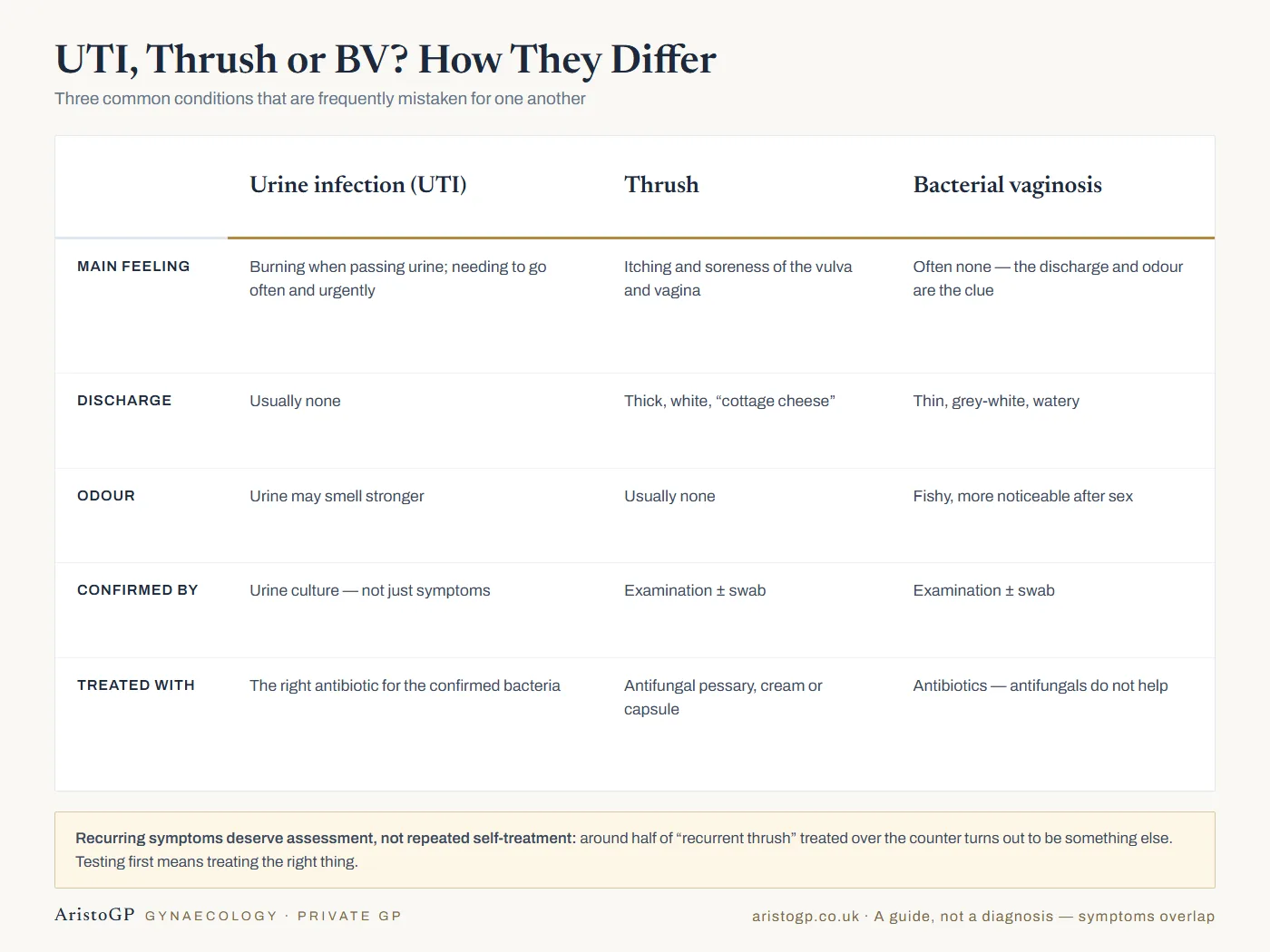
Comparison chart of UTI, thrush and bacterial vaginosis symptoms: burning, discharge, odour, how each is confirmed and treated
How urine infections, thrush and bacterial vaginosis differ — a guide, not a diagnosis.

What to expect

Finding out what is really causing it

Culture, not guesswork

A urine sample sent for culture and sensitivities, so treatment is chosen against the organism actually present rather than the likeliest one.

The menopause connection

After the menopause, thinning of the tissue around the urethra causes symptoms that mimic infection exactly. Local oestrogen often reduces recurrence substantially.

Examination

Assessment of the vulva, vagina and pelvic floor, since prolapse, atrophy and incomplete emptying all contribute.

Pelvic ultrasound

Where it is indicated, imaging to check the bladder empties properly and to look for other pelvic causes.

Prevention

What genuinely reduces recurrence and what does not. Several widely repeated measures have no evidence behind them.

When to refer

Blood in the urine, loin pain or repeated proven infections need urological assessment, and that is arranged rather than deferred.

Why it keeps happening

What lies behind recurrent infections

Reinfection or a persistent infection

These need different treatment. Repeated infections with the same organism suggest something is not being cleared; different organisms each time points towards reinfection. Culture results over time are what separate the two.

Oestrogen and the menopause

After the menopause, falling oestrogen thins the vaginal and urethral tissue and changes the normal bacteria, which makes infection easier. Topical vaginal oestrogen is one of the most effective preventive measures available and is often simply never offered.

Incomplete bladder emptying

Urine left in the bladder gives bacteria time to multiply. Prolapse, pelvic floor dysfunction and some medications contribute. An ultrasound can show whether the bladder is emptying properly.

Antibiotic resistance

Repeated courses prescribed without a culture select for resistant organisms, so each episode becomes harder to treat. This is the main reason we culture first and treat second wherever symptoms allow it.

When it is not infection at all

Interstitial cystitis, bladder pain syndrome and vaginal atrophy all cause burning and urgency with negative cultures. Being told repeatedly that nothing was found is a reason to look further, not to stop looking.

What prevention actually helps

Adequate fluids, treating constipation, vaginal oestrogen after the menopause and, in selected cases, prophylactic antibiotics or non-antibiotic options. What suits you depends on the pattern, which is why the history matters.

Fees

Published fees

Gynaecology Consultation
Full consultant consultation

£200

Consultation + Pelvic Ultrasound
Same-day scan and results

£300

Complete Well Woman Check
Consultation, ultrasound and cervical screening

£380

If anything needs adding on the day

If a test is needed during your appointment it is £80 — cervical cytology, chlamydia and gonorrhoea, a urine culture, or a high vaginal swab. The full seven-infection STI panel is £220.

Nothing is added without being discussed with you first, and it is decided in the room rather than chosen at booking, so you are not paying for a test before anyone knows whether you need it. See every fee.

Book an assessment

Same-day appointments at 1-5 Portpool Lane. Please bring a list of the antibiotics you have already had, including anything taken abroad, as that history shapes what is worth testing.

After your assessment, the doctor will explain the findings and guide you on the most appropriate next steps. Depending on what is found, this may include monitoring, further tests, a prescription, treatment we can offer at the clinic, or referral to another specialist or service. Not every condition can be treated at AristoGP, and an appointment does not guarantee a particular treatment or prescription.

Frequently asked questions

Why do my urine infections keep coming back?

Sometimes because the original infection was never fully cleared, sometimes because the organism was resistant to the antibiotic used, and often because something is making recurrence more likely: menopausal changes, incomplete bladder emptying, or prolapse. Culture and examination separate these.

I keep being given antibiotics. Is that a problem?

Repeated empirical courses select for resistant organisms and disturb the vaginal flora, which can itself cause symptoms. That does not mean antibiotics are wrong, but it does mean the diagnosis should be confirmed rather than assumed each time.

Could it be the menopause rather than infection?

Frequently, yes. Falling oestrogen thins the tissue around the urethra and bladder, producing urgency, frequency and burning that are indistinguishable from cystitis. Local vaginal oestrogen reduces recurrent urinary symptoms substantially in postmenopausal women.

Does cranberry or D-mannose work?

The evidence for cranberry is weak and inconsistent, and it is not a treatment for an active infection. D-mannose has some supportive data but is not established. Neither is a substitute for finding out why the infections recur.

When do I need to see a urologist?

Visible blood in the urine, loin pain with fever, repeated culture-proven infections, or symptoms that do not respond to appropriate treatment. Those warrant urological assessment, and it is arranged rather than left with you.

What should I bring?

A list of the antibiotics you have taken, including anything bought or prescribed abroad, and any previous urine results if you have them. Ideally do not start a new antibiotic in the days before the appointment, so a sample can be cultured.

Scroll to Top
Book Gynaecology Appointment →
WhatsApp us