

A transvaginal ultrasound is a scan of the uterus, ovaries and surrounding area using a slim probe placed gently in the vagina. Because the probe sits close to the pelvic organs, it gives much clearer pictures than a scan through the abdomen.
If you have been told you need one, it is normal to feel a bit apprehensive. This guide explains exactly what happens, whether it hurts and how to prepare.
Transvaginal or abdominal: what is the difference?
There are two ways to scan the pelvis, and they are often used together:
- Transabdominal: the probe moves over your lower abdomen with gel. It gives a wider view and is useful for large fibroids or cysts, but the detail is limited and you usually need a full bladder.
- Transvaginal: the probe is placed in the vagina. It gives the most detailed view of the lining of the uterus, the ovaries and small structures, and your bladder should be empty.
If you have never had penetrative sex, or would prefer not to have an internal scan, tell the person scanning you. A transabdominal scan can be done instead, and it still answers many questions.
What happens during the scan
- You are asked to empty your bladder.
- You undress from the waist down in private and lie on the couch with a sheet covering you, knees bent.
- The probe, which is slightly wider than a tampon, is covered with a protective sheath and lubricating gel.
- It is moved gently to look at the uterus and each ovary.
- The scan usually takes 10 to 20 minutes.
You can ask to stop at any point. You are welcome to bring someone with you.
Does a transvaginal ultrasound hurt?
For most people it is not painful. You feel pressure and some mild discomfort, similar to having a smear test or inserting a tampon, and less than many expect. It can be more uncomfortable if you have endometriosis, a tender pelvis or vaginal dryness after the menopause.
Pain during the scan can itself be useful information, for example tenderness over an ovary. Say if anything hurts, and the pressure or angle can be adjusted.
How to prepare
- Bladder: empty for a transvaginal scan. If a transabdominal scan is planned too, you may be asked to arrive with a comfortably full bladder and then empty it.
- Clothing: a top with a skirt or trousers is easier than a dress.
- Latex allergy: let us know when you book.
- Bring: any previous scan reports and the date of the first day of your last period.
Can I have a transvaginal scan on my period?
Yes. Bleeding does not stop the scan or make it unsafe, and many scans are done during a period. For some questions the timing in your cycle matters, for example measuring the lining of the uterus or looking for polyps, which are best seen just after a period. If you are booking for a specific reason, ask whether to time it.
Is it safe in pregnancy?
Yes. Ultrasound uses sound waves, not radiation, and a transvaginal scan does not harm a pregnancy. In the first weeks of pregnancy it is the best way to confirm the pregnancy is in the uterus and to see a heartbeat. See our early pregnancy scan page.
What a transvaginal ultrasound can show
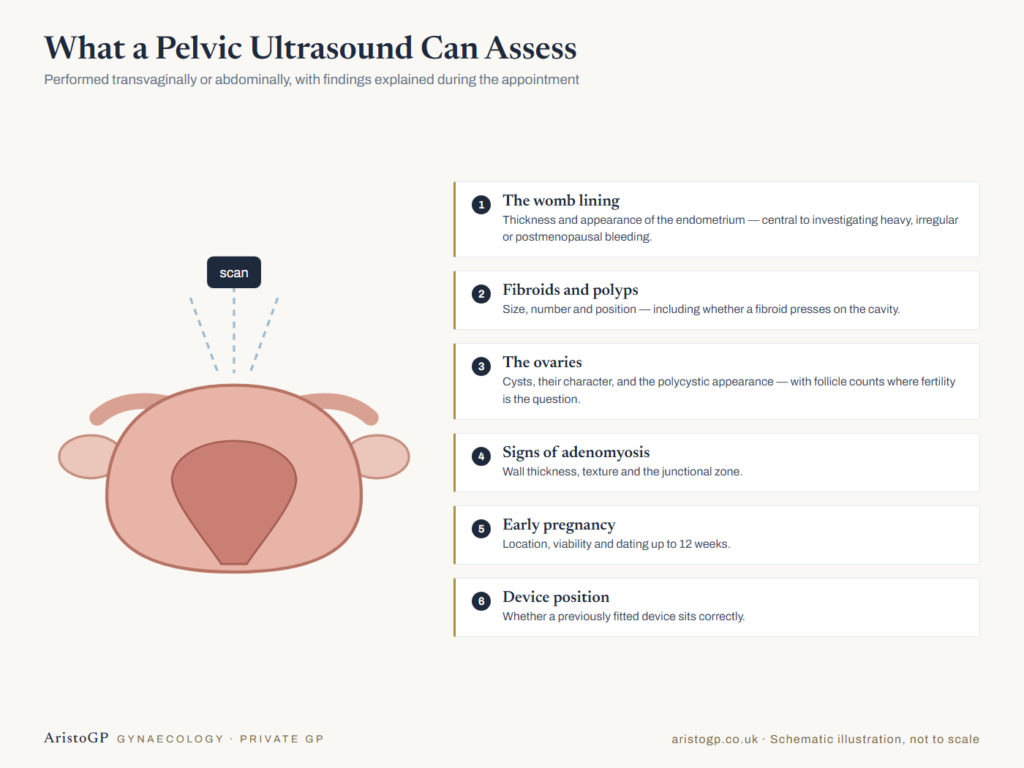
- Fibroids: their size, number and position
- Ovarian cysts and what type they are likely to be
- The thickness of the lining of the uterus, and polyps
- Signs of adenomyosis
- Polycystic-appearing ovaries, as part of a PCOS assessment
- Early pregnancy, and the position of a coil
It has limits. Small patches of endometriosis are often not visible on ultrasound, and the fallopian tubes usually cannot be seen unless they are abnormal. A normal scan does not rule out every cause of pelvic pain.
When will I get the results?
In many NHS and private settings, a sonographer performs the scan and the report goes to your doctor days later. At AristoGP, the consultant gynaecologist performs the scan herself during your consultation, so the findings are explained and a plan agreed before you leave.
Private transvaginal ultrasound in London
At AristoGP, 1-5 Portpool Lane, London EC1N 7UU, scans are part of a consultation with Dr Anastasia Mermigka:
- Consultation with pelvic ultrasound: £300
- Early pregnancy scan: £240
- Follow-up pelvic ultrasound (if you have been seen before): £200
No GP referral is needed, and same-day appointments are often available. More detail is on our private pelvic ultrasound page.
Frequently asked questions
Is a transvaginal ultrasound painful?
For most people it causes pressure and mild discomfort rather than pain, similar to a smear test. Tell the person scanning you if it hurts, and they can adjust the probe or stop.
Do I need a full bladder for a transvaginal ultrasound?
No. Your bladder should be empty for a transvaginal scan. A full bladder is only needed for a scan through the abdomen.
Can I have a transvaginal ultrasound if I am a virgin?
You can choose not to. A transabdominal scan through the lower abdomen can be done instead and still answers many questions.
How long does a transvaginal ultrasound take?
The scan itself usually takes 10 to 20 minutes.
How much is a private transvaginal ultrasound in London?
At AristoGP a consultation with pelvic ultrasound costs £300, with the scan performed and explained by a consultant gynaecologist in the same visit. An early pregnancy scan is £240.
Related care and reading
Book a consultation with pelvic scan.